Privateers and stolen sturgeon
Sturgeon historyPrivateers and stolen sturgeon
The story of stolen sturgeon reveals the fish’s value in the 16th century. We trace a privateer’s catch through the royal accounts.
In 1565, Stockholm’s treasury recorded receiving nine barrels and three quarter-barrels of pickled sturgeon from Lasse Olsson, captain of a privateering ship. He had acquired the sturgeon by capturing Danish ships.
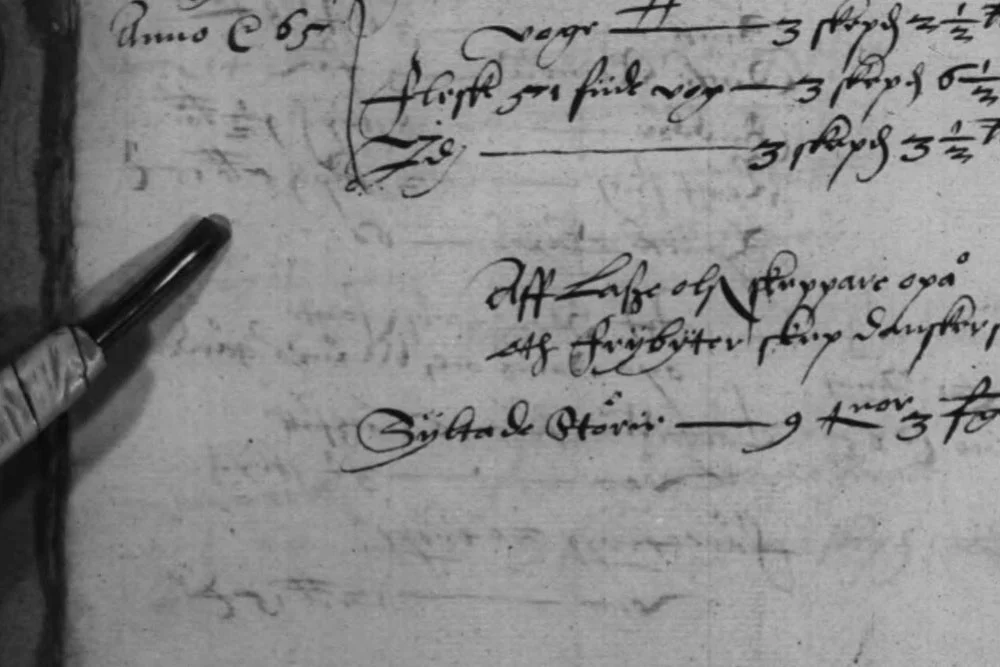
Stolen sturgeon in the royal archives
This happened during the Northern Seven Years’ War between Sweden and Denmark, from 1563 to 1570. The sturgeon’s origin is therefore uncertain, but the cargo probably came from Denmark or may have been purchased in German towns. At the time, Halland, Skåne, Blekinge and Gotland were part of Denmark, along with Norway and Bohuslän.
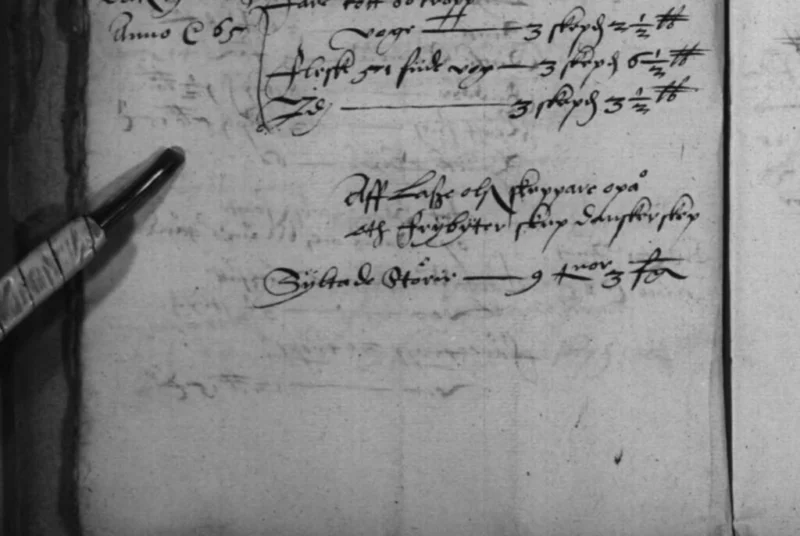
This record shows the receipt of sturgeon at Stockholm Castle in 1565: “From Lasse Olsson, captain of a privateering ship. Danish ships – pickled sturgeon – nine barrels and three quarter-barrels.”
The pickled sturgeon was consumed over two years. In 1565, one and a half barrels were sent to Stockholm Castle on 20 September, one and a half to His Majesty’s pantry on 4 July, and half a barrel to the princesses’ pantry on the same day. The princesses were probably Sofia and Elisabeth Vasa, Gustav Vasa’s unmarried daughters. Both were in their late teens and would later become potential marriage partners in peace negotiations. The delivery to their pantry was signed for by their steward, who acknowledged only the half-barrel of sturgeon.
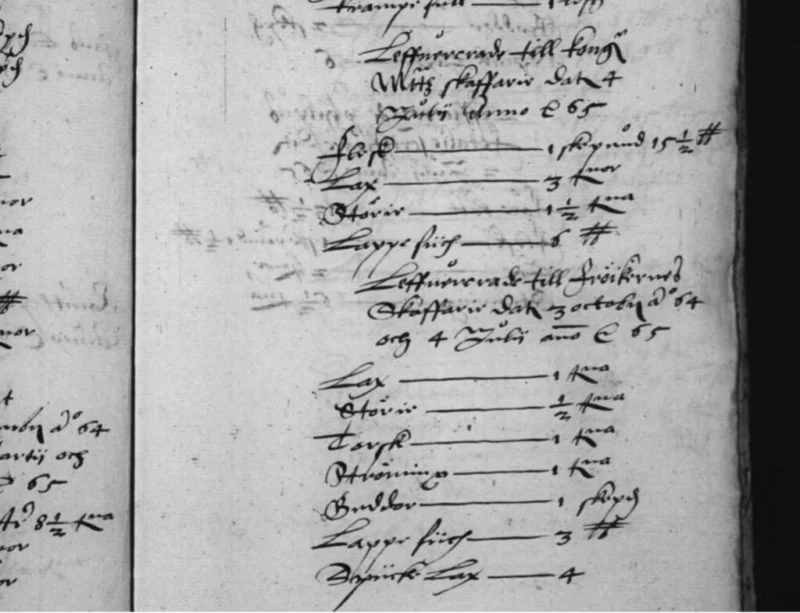
This record shows deliveries of sturgeon to different recipients. At the top: delivery to His Majesty’s pantry on 4 July 1565, including one and a half barrels of sturgeon alongside pork, salmon and whitefish described using an outdated term in the original record. Below: deliveries to the princesses’ pantry on 3 October 1564 and 4 July 1565. Half a barrel of sturgeon appears on the second line from the top.
In total, three and a half barrels of pickled sturgeon were issued in 1565, leaving six barrels and one quarter-barrel for 1566. The reduction from three quarter-barrels to one probably means that one of the half-barrel deliveries actually consisted of two quarter-barrels, or that two quarter-barrels were opened to fill a half-barrel.
The remaining barrels were consumed in 1566. Påvel, the kitchen clerk, signed for four and a half barrels for His Majesty’s pantry on 29 July, and one and a half barrels were delivered to Stockholm Castle on 28 September: six barrels in total. The half-barrel quantities suggest that barrels had been opened and their contents divided between two smaller containers.
Only one quarter-barrel of pickled sturgeon remained. This was recorded as outstanding after “Karl Simonsson unlawfully took one quarter-barrel of sturgeon from the castle”.
We have not been able to establish who Karl Simonsson was. His name does not appear among the bailiffs, captains or others working at the castle. One possibility is that he supplied goods to a provincial bailiff and took the sturgeon when collecting goods for his employer. Recording it as “outstanding” suggests that Karl, or his employer, was probably charged its value as a debt.
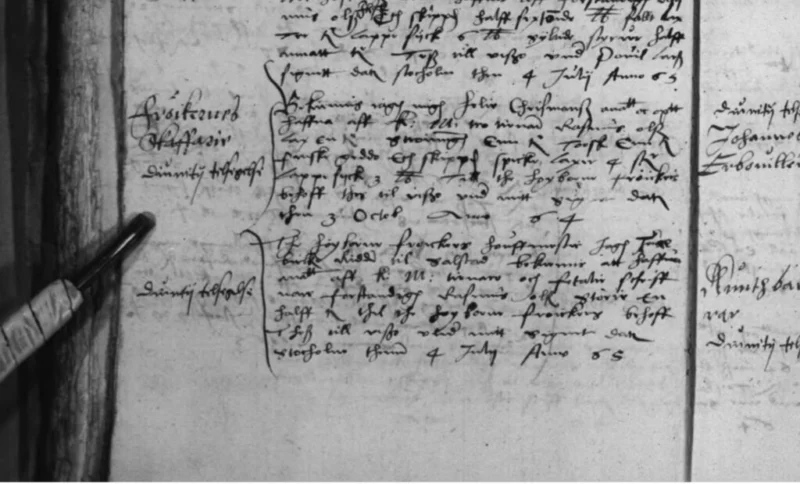
This is what a receipt for goods issued looks like. The left-hand margin reads “The princesses’ pantry”. A bracket marks two withdrawals for the princesses. The lower entry, dated 4 July 1565, shows that their steward collected, among other things, half a barrel of sturgeon for their use. The word for sturgeon, “Störie”, is on the fourth line from the bottom, second word from the right.